SWIFT WATER DESIGN & PROCESS BASED RESTORATION IN THE MEDIA
Kevin Swift and Swift Water Design are ambassadors for Process Based Restoration, appearing regularly in press, in conferences, and at on-site learning centers in the US and abroad.
Kevin Swift, owner of Swift Water Design, has dedicated his career to restoring meadows in the Sierra Nevada — specifically one a few miles above Shaver Lake called the Lower Grouse Meadow, which was severely affected by the 2020 Creek Fire. As a result of the fire, that area is surrounded by barren hillsides and blackened, charred pine trees. Swift and his team managed to restore this meadow by building small dams along a stream — replicating what animals would have done.
It would be an understatement to say that Kevin Swift loves the outdoors. Swift, slender, goateed and with a dirty blond ponytail, has built a company— and career —out of emulating a furry, charismatic woodland mammal. Here’s a hint: he forages for tree limbs and mud to build dams.
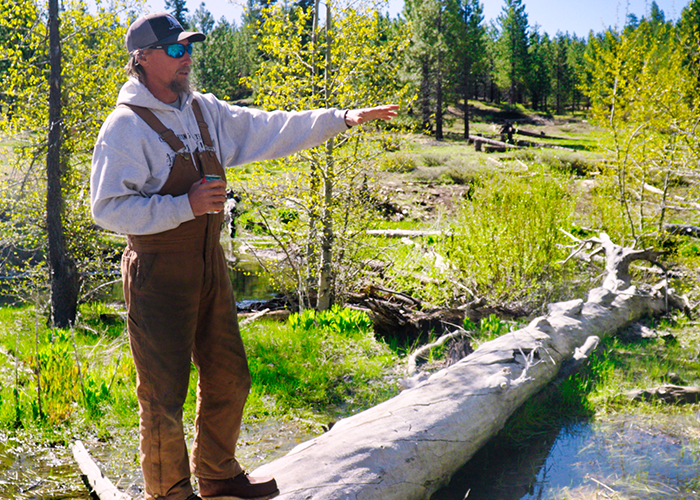
“We’re pretending that we’re beavers,” Swift said. “A thousand percent.” Swift restores meadows and other habitats that have been damaged and destroyed. On a recent day, he stood at a meadow he helped to restore, just a few miles above Shaver Lake in the Sierra Nevada.
On this week’s episode, Terra Verde host and producer Hannah Wilton speaks with two of California’s leading beaver advocates: Kate Lundquist from the WATER Institute’s Bring Back the Beaver Campaign and Kevin Swift from Swift Water Design, a process-based restoration company focused on beaver mimicry and coexistence alternatives. Together, they unpack the history and ecosystem benefits of beaver and share how we can partner with these wetland engineers to help heal California’s waterways.
A brief recap of the first project on the Ségur farm for the Maple program, a storytelling initiative about biodiversity, of which the MAPCa association is a laureate. In French with English subtitles.
Swift Water Design collaborators and Yellow Creek project partners at the Occidental Arts & Ecology Center (OAEC) have been working for the past decade to update and improve beaver restoration policy and practices at the state level through their Bring Back The Beaver Campaign.
Having worked with the Maidu Summit Consortium in ways to support the return of beaver and detailing many recommendations in a ‘Beaver Recruitment Strategy’, they too were thrilled to see their hard work pay off when the governor included beaver restoration in his new budget announcement this spring.
Kevin Swift, founder of Swift Water Design, led the team installing the BDAs in the first of what will be several phases. “It’s process-based restoration rather than using diesel and rock and insisting on imposing a form on the river,” he says. “Instead, we use the power the stream brings us and introduce materials that give the stream something to work with. Those structures drive channel evolution and add roughness and complexity—with a small bit of human nudging you can begin to correct structurally starved streams.”
Filmed during the ARRA² training course on “Low-Tech River Regeneration Based on Processes,” which took place in April 2024 in the Drôme region of France. The course provides a unique immersion into gentle approaches to regenerating our aquatic ecosystems. Building on its success and to meet the demand for a better understanding of this topic, two new sessions were held in 2025, and this technical program is expected to be offered again in 2026.